
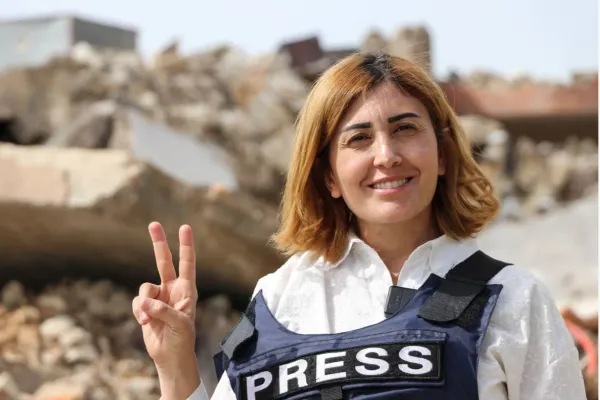
Amal Khalil remained trapped beneath the rubble for at least six hours before the Lebanese army, civil defense teams and the Lebanese Red Cross were eventually able to access the scene and recovered her body. X
Amal Khalil, a 43‑year‑old Lebanese journalist and correspondent for the Beirut-based daily newspaper Al‑Akhbar, was known for her decades of fearless reporting from southern Lebanon. Her name, Amal (meaning “hope” in Arabic), became tragically symbolic when she was killed in an Israeli airstrike.
Born in 1984 in al‑Baisariyah in the Sidon District, Khalil grew up during the Israeli occupation of southern Lebanon. According to publicly available biographical sources, she later became a prominent voice documenting Israeli demolitions, occupation, and human rights abuses in the region. Colleagues described her as generous, courageous, and deeply knowledgeable about the south, often sharing contacts and resources with other journalists. Reporting from outlets such as Middle East Eye highlighted her commitment to truth‑telling and the impact repeated attacks had on her worldview.
Career and Reporting
Khalil began her career covering the 2006 Israeli war on Lebanon, which resulted in:
- Israel reporting 119 soldiers killed and 750 injured
- Israeli civilian casualties totaling 39 killed and several hundred injured
- Hezbollah reporting 71 fighters killed
- Lebanese civilian casualties reaching 1,077 — a stark indication of which side bore the brunt of civilian harm.
The IDF Left Khalil to Bleed to Death
On April 22, 2026, Khalil was killed in the village of al‑Tiri in southern Lebanon while reporting on an Israeli strike. She and freelance photojournalist Zeinab Faraj were covering the aftermath when a vehicle near them was hit. They fled to a nearby house for shelter, but Israeli forces struck the building twice — the first strike killed two civilians, and the second killed Khalil.
Reports circulated that Khalil had previously received threatening text messages warning her to stop reporting. A Red Cross ambulance managed to rescue Faraj from under the rubble but was unable to reach Khalil due to heavy fire.
Journalists shared the following statements:
- Al Jazeera’s Heidi Pett reported that Khalil had received threats from an Israeli WhatsApp number warning her to stop reporting or leave Lebanon “if she wanted her head to remain on her shoulders.”
- In a separate interview, Khalil herself said: “I received direct threats targeting me on my phone from the Mossad, from the Israelis, and they threatened to kill me.”
On that dreadful day, the world learned that Lebanese journalist Amal Khalil had been killed while covering an Israeli raid on a southern Lebanese village.
A Comparison to the U.S. Response in 2006
The U.S. State Department did not issue a strong condemnation of Khalil’s killing. To illustrate this contrast, consider the U.S. response to the 2006 murder of Russian journalist Anna Politkovskaya in Moscow. At that time, the U.S. described her killing as a “heinous crime” and called for the arrest of her killers. Politkovskaya, like Khalil, had exposed military abuses and government corruption.
Some commentators argued that the muted U.S. response to Khalil’s death reflected a double standard. U.S. Ambassador Mike Huckabee to Israel stated, “Accusing Israel of any wrongdoing is like insulting my wife of infidelity,” prompting criticism from those who believed the U.S. should demand accountability.
Reactions from Journalists and Activists
Commentators on social media criticized how major news outlets covered Khalil’s death. One user wrote that coverage failed to mention the threats she received, the blocked rescue efforts, or the circumstances under which she bled to death under rubble.
Activist Medea Benjamin of CODEPINK noted the contrast between journalists celebrating at the White House Correspondents’ Dinner and the silence surrounding the deaths of reporters in conflict zones. She argued that history would remember who spoke up and who remained silent.
https://x.com/codepink/status/2048188384166690917?s=20
Others shared firsthand accounts from southern Lebanon, emphasizing the dangers journalists face while reporting on the conflict. Here is a tweet by my friend Rania @umyaznemos shared the day after Khalil's murder titled " An honest report from South Lebanon.
https://x.com/umyaznemo/status/2047926013133283680?s=20
Heidi Pett from Al Jazeera English filed this report by revealing the threats received by Khalil from an Israeli WhatsApp number during the last war, warning her to "stop reporting or leave Lebanon if she wanted her head to remain on her shoulders," before being killed in an Israeli attack.
https://x.com/AJEnglish/status/2047090177353355458?s=20
A Deadly Pattern
Observers have noted that journalists in the region face extraordinary risks. Reports have claimed that Israel has killed journalists in Gaza, Lebanon, Yemen, and Iran in recent years, including 17 Lebanese journalists. International Humanitarian Law recognizes journalists as civilians and seeks to protect them, yet the dangers persist.
Killed While Covering a Ceasefire
Khalil was killed while covering what was described as a ceasefire violation. The ceasefire itself had reportedly been negotiated and ordered by President Trump.
“I received direct threats targeting me on my phone from the Mossad, from the Israelis, and they threatened to kill me.” Lebanese journalist Amal Khalil speaking before she was killed by Israel.
https://x.com/Lowkey0nline/status/2047248398877671761?s=20
Many journalists remain primary witnesses to alleged war crimes. For this reason, some argue that journalists are targeted because their reporting could later serve as evidence in legal proceedings.
Mahmoud El‑Yousseph is a Palestinian freelance writer and retired U.S. Air Force veteran. He writes on U.S. foreign policy, Middle East affairs, and justice. Email: elyousseph6@yahoo.com